Open your worlds
Your wish list — the plush you mean to keep.
Press Add to a collection on any plush in the shop: start a collection of your own, or keep it on your wish list. Sign in and both follow you to any device.
Open my wish list →Menu
The real dachshund
The dachshund is a German breed of dog with short legs and a long body. Here are three true things about it.
A badger dog
The name dachshund is German. It means 'badger dog', from Dachs, which means badger, and Hund, which means dog.
SourceThree kinds of coat
A dachshund's coat may be smooth-haired, wire-haired or long-haired, and it comes in various colours.
SourceDifferent sizes
Dachshunds come in three sizes: standard, miniature and kaninchen, which is German for rabbit. Clubs in the United Kingdom and the United States do not recognise the rabbit size.
Source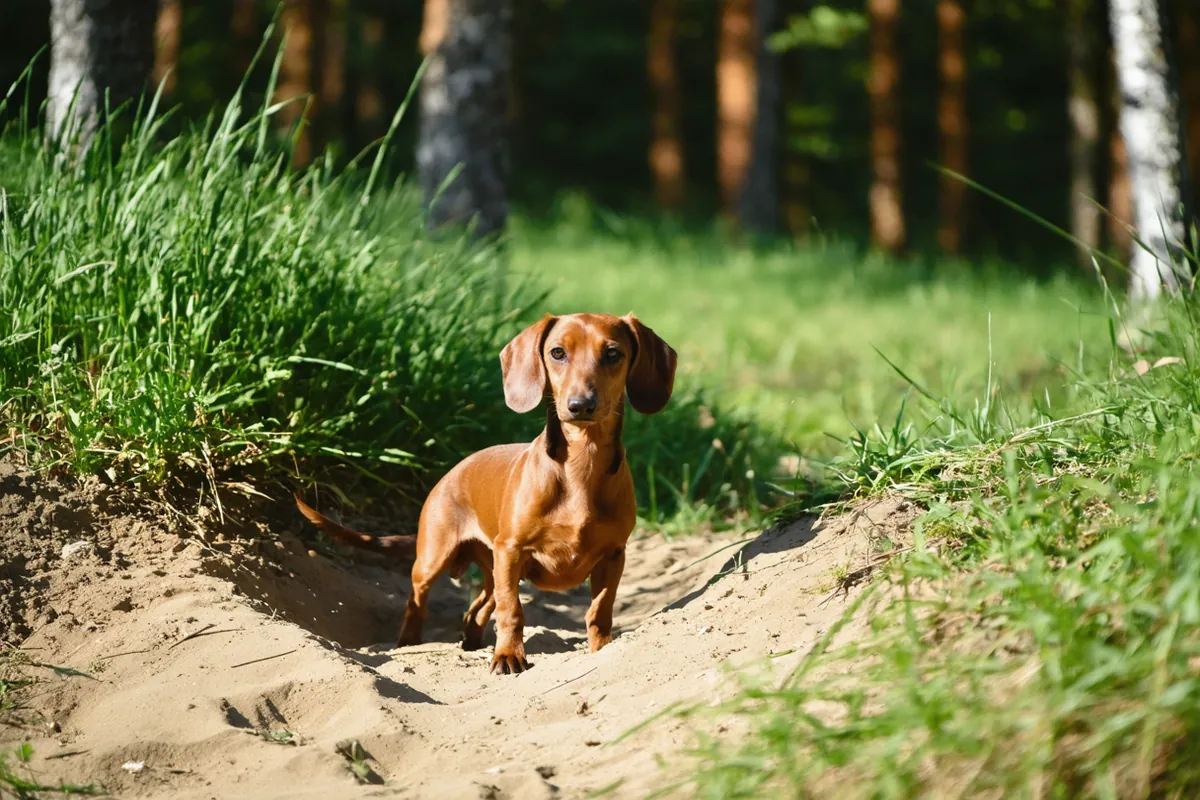
AI-generated illustration
Built to dig
A dog made for burrows
The dachshund was bred to scent, chase and flush out badgers and other animals that live in burrows. The miniature dachshund was bred to hunt small animals such as rabbits. Its body suits the job. A typical dachshund is long-bodied and muscular, with short stubby legs. Its front paws are large and shaped like paddles, which makes them very good for digging. Even its curved tail was bred on purpose. It helps people see the dog in long grass, and for dogs that go into burrows, it can be used to haul the dog out if it gets stuck. Dachshunds can have a loud bark, too.
SourceOlympic mascot
Waldi, the dog of the Munich Games
The first official Olympic mascot was a dachshund called Waldi, made for the 1972 Summer Olympics in Munich, Germany. The German designer Otl Aicher created him, using a real long-haired dachshund named Cherie von Birkenhof as his model. Waldi was meant to show what athletes need: resistance, tenacity and agility. He appeared in several different colour schemes, and over two million Waldi items were sold around the world. The marathon route was even laid out in Waldi's shape. The runners went around his ears, along his belly and his back, and then into the Olympic Stadium.
SourceThe pictures on this page are AI-generated illustrations, not photographs. The facts are checked against the sources linked.