Open your worlds
Your wish list — the plush you mean to keep.
Press Add to a collection on any plush in the shop: start a collection of your own, or keep it on your wish list. Sign in and both follow you to any device.
Open my wish list →Menu
The real monkeys
Monkeys include Old World monkeys and New World monkeys. Here are three true things about them.
Two worlds
Old World monkeys are found in Africa and Asia. New World monkeys live in Mexico, Central America and South America.
SourceLook at the nose
Most Old World monkeys have small, curved nostrils set close together. Most New World monkeys have round nostrils set far apart.
SourceTails and pouches
Some New World monkeys, such as spider monkeys, have tails that can grab and hold, called prehensile tails. Macaques and some other Old World monkeys have cheek pouches, but New World monkeys do not.
SourceMonkey babies
Riding, changing colour and playing
Monkey babies are helpless at birth, so they get rides by clinging to their mothers. Some kinds of monkey have babies that are a completely different colour from their parents. Adult colobus monkeys have black hair, but a newborn is white, and langur babies are orange. The colour usually changes within the first six months. Marmosets and tamarins do things differently. The fathers have almost all the responsibility. They carry the babies on their backs and watch over them, only handing them to their mother for feeding. These monkeys regularly have twins or triplets. When the troop is not travelling, monkey babies stay very active and spend much of their waking hours playing.
SourceMonkey talk
How a troop gets along
Monkeys are very social, so it is important that they communicate well to get along in their large groups. Groups of monkeys, called troops, travel together by day to find food. Monkeys use barks, screams, grunts, squeaks, hoots, wails and moans to talk to one another. Staring is a threat in monkey society. To keep family bonds, monkeys groom each other every day. Grooming seems to be a way to make up after a fight, or to make friends with other members of the troop. Vervet monkeys even have different alarm calls for different predators, such as eagles, pythons and leopards.
SourceThree remarkable monkeys
Black howler monkey
Alouatta caraya
The call of howler monkeys is one of the loudest calls made by any land animal. Under certain conditions, a howler's call can be heard from about 4.8 kilometres away. Black howler males have a black coat, while females are blonde.
Source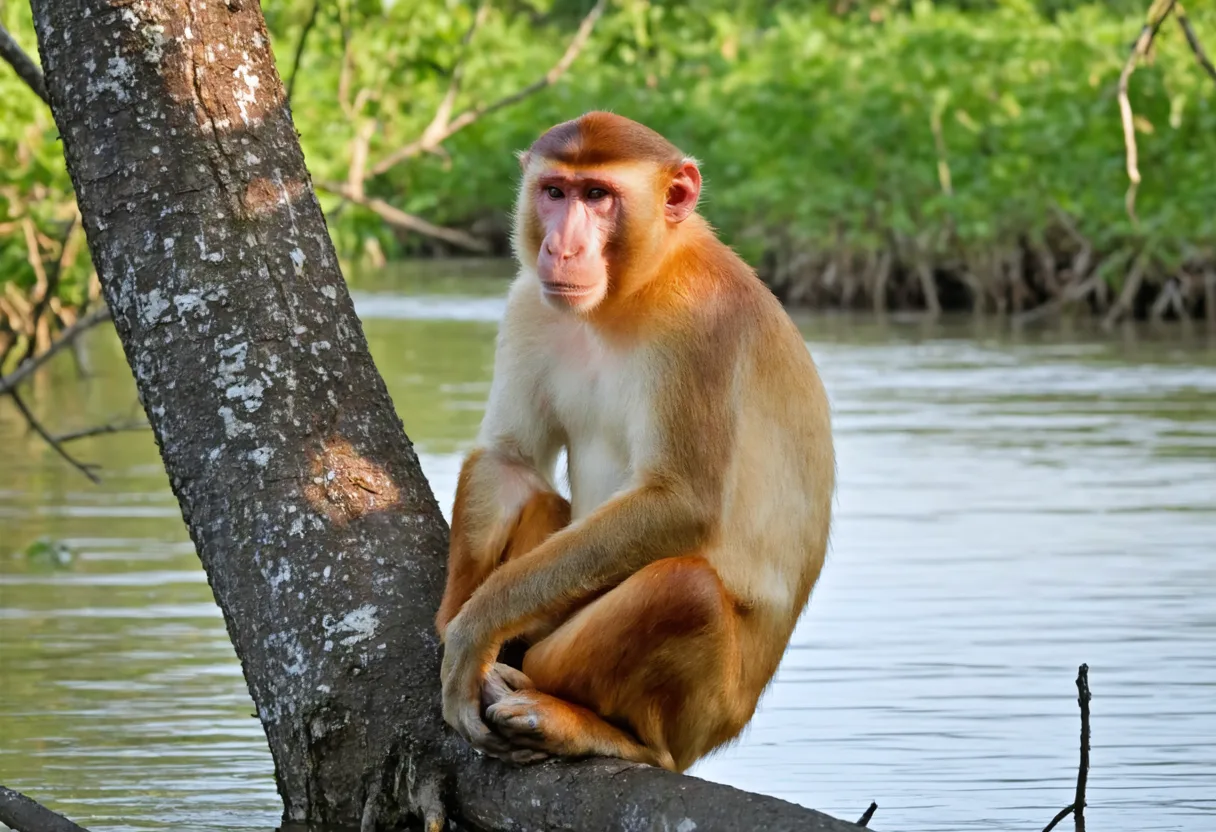
A proboscis monkey in a tree beside a river
Proboscis monkey
Nasalis larvatus
Proboscis monkeys live only on the island of Borneo. A male's large nose makes his calls louder than a female's. Webbed fingers and toes help them move about their river and coastal homes, and they doggy-paddle across rivers.
SourcePygmy marmoset
Cebuella pygmaea
Pygmy marmosets are the smallest monkeys in the world, at just over 100 grams. They live in rainforests of the western Amazon Basin. They gnaw holes in tree bark, and when the sap puddles up in the hole, they lap it up with their tongues.
SourceThe pictures on this page are AI-generated illustrations. The facts are checked against the sources linked.