Open your worlds
Your wish list — the plush you mean to keep.
Press Add to a collection on any plush in the shop: start a collection of your own, or keep it on your wish list. Sign in and both follow you to any device.
Open my wish list →Menu
Wonders of the Atlantic puffin
The Atlantic puffin (Fratercula arctica)
↑ All about puffinsThe real Atlantic puffin
The UK is home to about 9 per cent of Europe's puffins. They breed on islands and sea cliffs around its coasts.
Summer colours
In summer, an Atlantic puffin's legs are usually a bright reddish orange. Outside the breeding season they turn a muted yellow, and its head and belly fade to grey.
SourceA tunnel home
Its nest is usually in a burrow about 1 to 2 metres long, or in a natural crack in the rock or under rocks. Both the male and the female help to dig.
SourceDiving for dinner
An Atlantic puffin finds its food while swimming under water. It does most of its fishing within about 15 metres of the surface, but it can dive to about 60 metres.
Source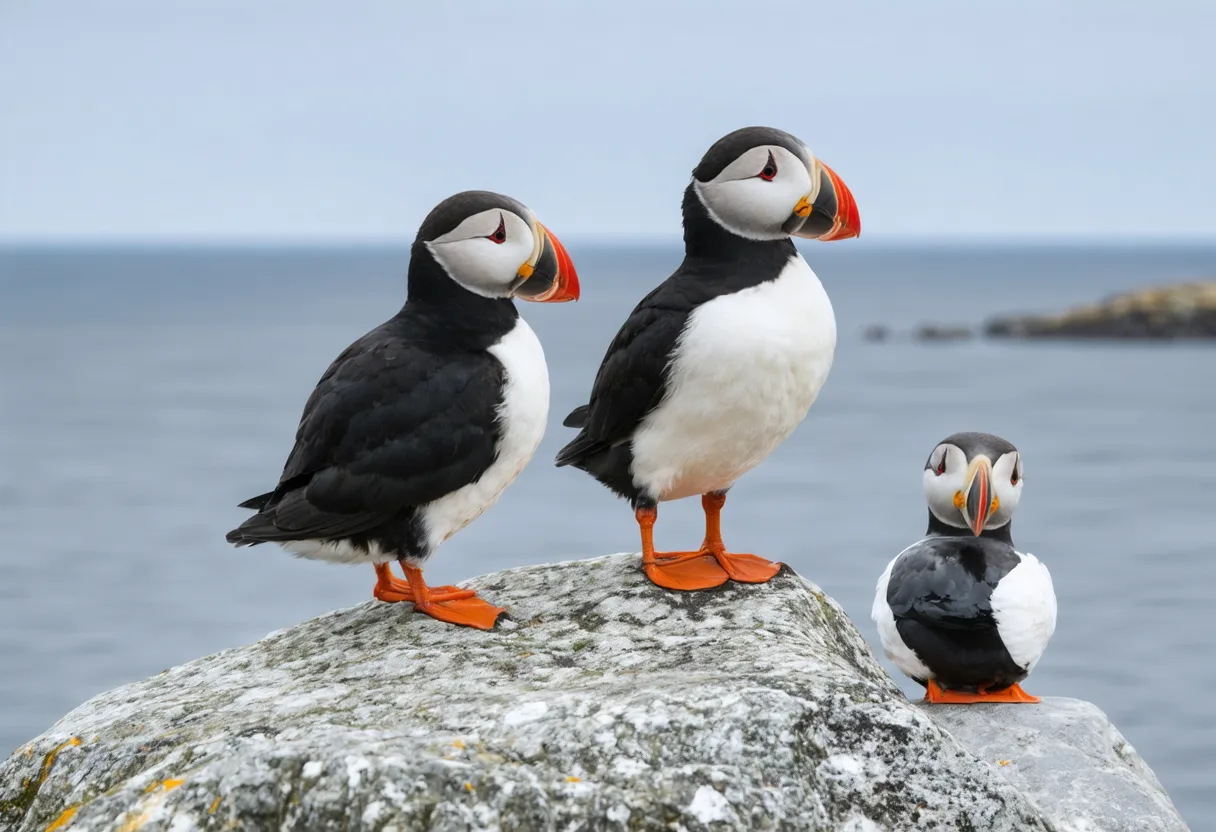
Puffins beside wooden puffin decoys on a boulder by the sea
Coming home
Bringing puffins back to Eastern Egg Rock
In 1973, puffins were nesting in only two places in Maine, in the United States. Dr Stephen Kress of the National Audubon Society wanted to bring them back to an island called Eastern Egg Rock. Young puffins usually return to breed on the island where they hatched. Young puffins about 10 to 14 days old were brought from Great Island, in Newfoundland. They lived in burrows made of turf for about a month, and each day biologists left handfuls of fish in their burrows. Between 1973 and 1986, 954 young puffins were moved, and 914 of them fledged. The first ones came back in June 1977. Wooden puffin decoys were set on the boulders to lure them ashore. In 1981, four pairs nested on the island.
SourceAn island summer
Puffin season on Skomer
Skomer is an island that is one of the most important seabird sites in southern Britain. Atlantic puffins start arriving there in mid-April. They are on the island from May to July. The first ones start leaving in mid-July, and by the end of July they have all gone. In 2026, 52,019 puffins were recorded on Skomer. They share the island with nearly 350,000 pairs of breeding Manx shearwaters, the largest colony in the world, and with guillemots, razorbills and kittiwakes. Skomer has no rats, which is important for birds that nest on the ground.
SourceThe pictures on this page are AI-generated illustrations. The facts are checked against the sources linked.