Open your worlds
Your wish list — the plush you mean to keep.
Press Add to a collection on any plush in the shop: start a collection of your own, or keep it on your wish list. Sign in and both follow you to any device.
Open my wish list →Menu
Wonders of the Bactrian camel
The Bactrian camel (Camelus bactrianus)
↑ All about camelsThe two-humped camel
The Bactrian camel is native to the steppes of Central Asia. It has two humps on its back, where the dromedary has one.
Humps that show hunger
When a Bactrian camel is well fed, its two humps are plump and upright. As food runs short, they shrink and lean to the side.
SourceIt can eat thorns
Its tough mouth can cope with sharp things such as thorns. Salt-loving plants are a necessary part of what it eats.
SourceFreezing winters, hot summers
Its coat can withstand cold as low as −30 °C in winter and heat up to 50 °C in summer.
Source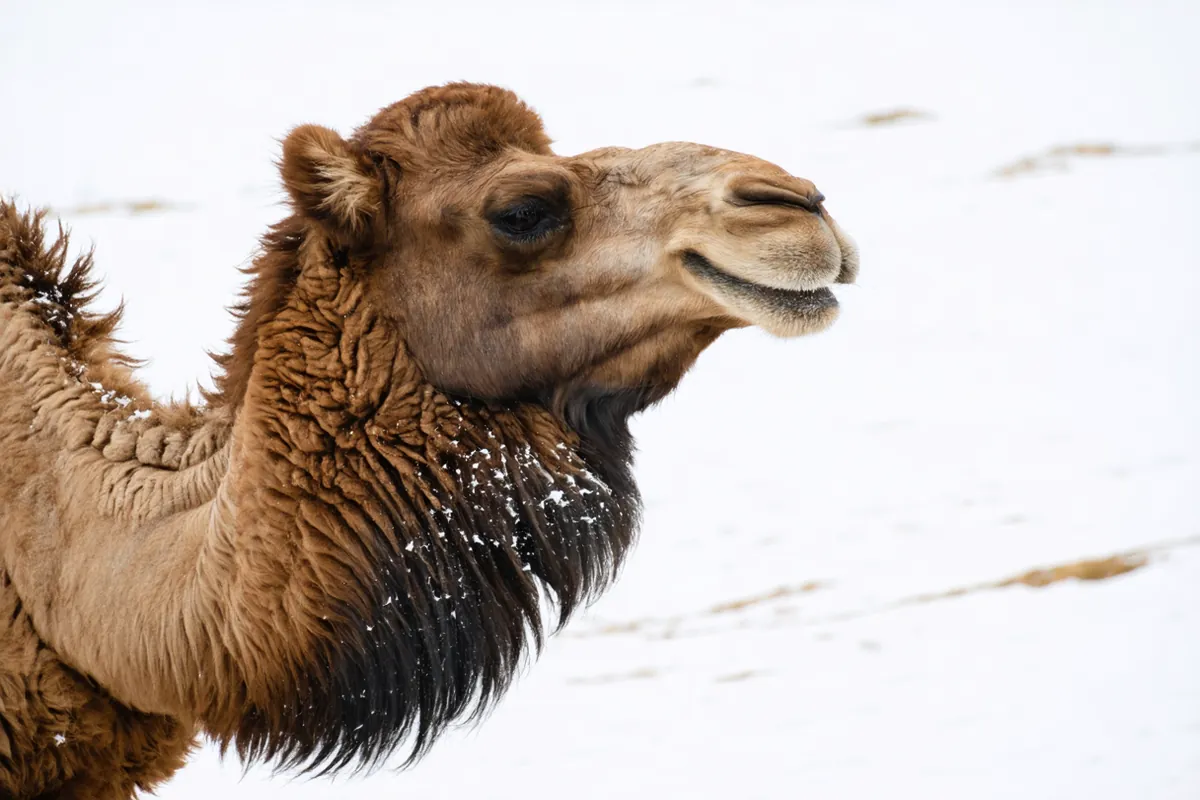
AI-generated illustration
Winter survivor
The camel that eats snow
Bactrian camels are native to the steppes of Central Asia, and most of them live in the Gobi Desert, in places that range from rocky mountains to flat steppe. In winter, for camels living above the snowline, snow and ice can be the only water there is. Bactrian camels belong to a fairly small group of animals that regularly eat snow to get the water they need. Warming snow and ice up to body temperature takes a lot of energy. So a Bactrian camel eats snow only in small amounts at a time.
SourceChanging coats
The great spring moult
A Bactrian camel's long, woolly coat can be any colour from dark brown to sandy beige. Its winter coat is long and shaggy. When the weather warms up, the camel sheds it extremely quickly. Huge sections peel off at once, so for a while the camel looks as if someone has given it a messy haircut. Shedding the coat helps the camel control its body temperature. People domesticated the Bactrian camel around 2500 BCE, and it has worked as a pack animal, carrying loads in inner Asia, since ancient times.
SourceThe pictures on this page are AI-generated illustrations, not photographs. The facts are checked against the sources linked.