Open your worlds
Your wish list — the plush you mean to keep.
Press Add to a collection on any plush in the shop: start a collection of your own, or keep it on your wish list. Sign in and both follow you to any device.
Open my wish list →Menu
Wonders of the European hedgehog
The European hedgehog (Erinaceus europaeus)
↑ All about hedgehogsThe real European hedgehog
In Britain, the hedgehog is the only spiny mammal. Here are three true things about it.
About 6,000 spines
A European hedgehog has around 6,000 closely packed spines. Each one is creamy white, brown at the base and pure white at the tip, with a dark chocolate-brown band just behind the point.
SourceFaster than it looks
Hedgehogs are usually thought of as slow, but they can move up to 40 metres a minute. They travel 1 to 2 kilometres a night.
SourceLegs under a skirt
A hedgehog has a short tail, small ears and fairly long legs. Its legs are normally hidden under a 'skirt' of long hairs.
Source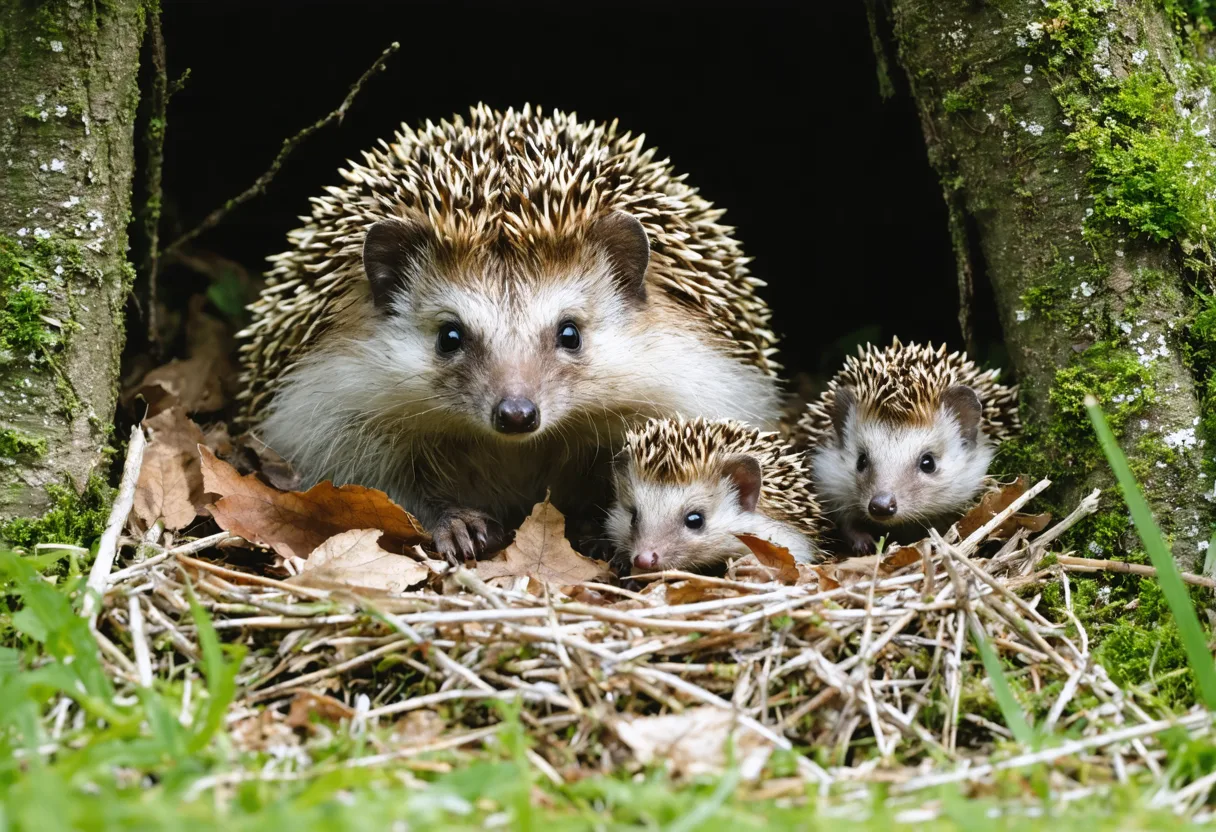
A European hedgehog with her hoglets beside their nest of leaves and grass
Summer babies
How hoglets grow their spines
European hedgehogs breed between April and September, most of all in May and June. Courtship involves lots of snorting. The babies, called hoglets, are usually born between May and August, in a nest of leaves and grass. There can be up to seven of them. They are born blind and without spines. Pure white spines appear soon after birth. Within a few weeks, darker spines grow through and replace them. Hoglets come out of the nest from the end of June onwards. A mother can try for two litters in a year, but she rarely raises more than one.
SourceFood and winter
A hedgehog's year
A European hedgehog uses its keen sense of smell to find food and to warn it of danger. It hunts for small creatures without backbones that live on the ground, especially worms, beetles, slugs, caterpillars, millipedes and earwigs. It also eats birds' eggs and carrion. Between November and the end of March, when food is scarce, hedgehogs hibernate to save energy, staying mostly still. A hedgehog lives for about two years on average, and a small number reach five. In Great Britain, around a third of hedgehogs have been lost since the year 2000.
SourceThe pictures on this page are AI-generated illustrations. The facts are checked against the sources linked.