Open your worlds
Your wish list — the plush you mean to keep.
Press Add to a collection on any plush in the shop: start a collection of your own, or keep it on your wish list. Sign in and both follow you to any device.
Open my wish list →Menu
Wonders of the great horned owl
The great horned owl (Bubo virginianus)
↑ All about owlsThe real great horned owl
The great horned owl is a big owl with two tufts of feathers on its head. Here are three true things about it.
Two continents
The great horned owl is found almost throughout North America and in much of South America.
SourceA big bird
It is 46 to 63 centimetres long, with wings 1.02 to 1.45 metres across. The female is larger than the male.
SourceA huge menu
Great horned owls have the most varied diet of all North American birds of prey. Their prey ranges in size from tiny rodents to geese and other birds of prey.
Source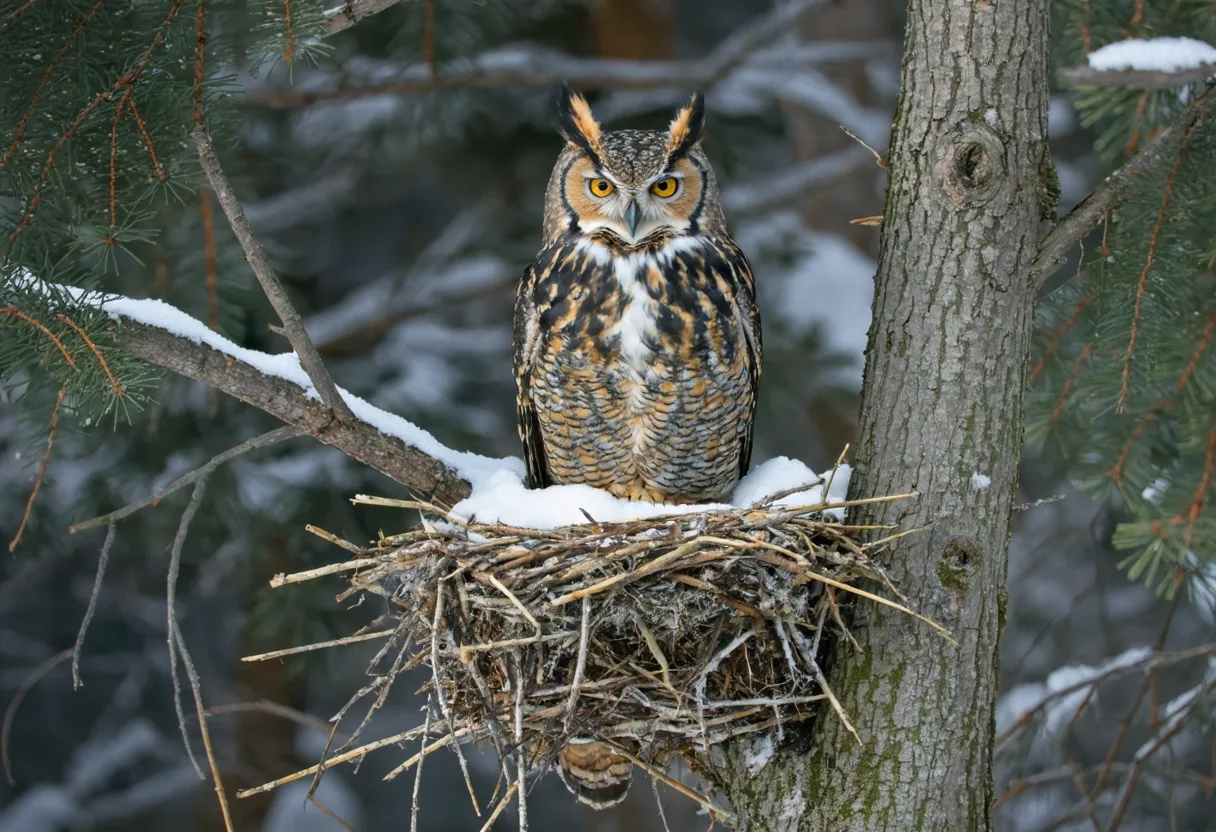
A great horned owl on its nest in a snowy pine
Winter nest
Nesting in the cold
In the north, great horned owls may begin nesting very early, in late winter. This may give the young owls time to learn to hunt before the next winter begins. They usually take over the old nest of another large bird, such as a hawk, crow or heron, often about 6 to 18 metres off the ground. They add little or no nest material of their own. The female lays two or three eggs and does most of the sitting, for 28 to 35 days. In winter in the north, an owl may store prey it has not eaten. Later it comes back and thaws the frozen animal by 'incubating' it.
SourceNight voices
The hoot owl
If you walk at night in the dunes of White Sands, in New Mexico, you may hear a great horned owl. Its song is a series of deep, soft hoots, though the number of hoots can change. In New Mexico the most usual call sounds like 'hoo-hoo-hooo, hoo-hoo', which is why people call them 'hoot owls'. They make other sounds too. Great horned owls can scream, screech, give barking notes, chuckle, squawk and even growl loudly. Young owls have a loud, raspy call of their own, which they use to beg for food.
SourceThe pictures on this page are AI-generated illustrations. The facts are checked against the sources linked.