Open your worlds
Your wish list — the plush you mean to keep.
Press Add to a collection on any plush in the shop: start a collection of your own, or keep it on your wish list. Sign in and both follow you to any device.
Open my wish list →Menu
The real Highland cow
The Highland is a Scottish breed of cattle. It comes from the Scottish Highlands and the Western Islands of Scotland.
A fold, not a herd
A group of cattle is usually called a herd, but a group of Highland cattle is known as a fold. Long ago, in winter, these cattle were kept at night in open stone shelters, also called folds, to protect them from the weather.
SourceA double coat
Highland cattle have an unusual double coat of hair. On the outside is oily hair, the longest of any cattle breed. Underneath is a soft, downy undercoat.
SourceMany colours
The usual colour is reddish brown, seen in about 60 per cent of Highland cattle. Some 22 per cent are yellow. The rest are pale silver, black, or brindle or dun.
Source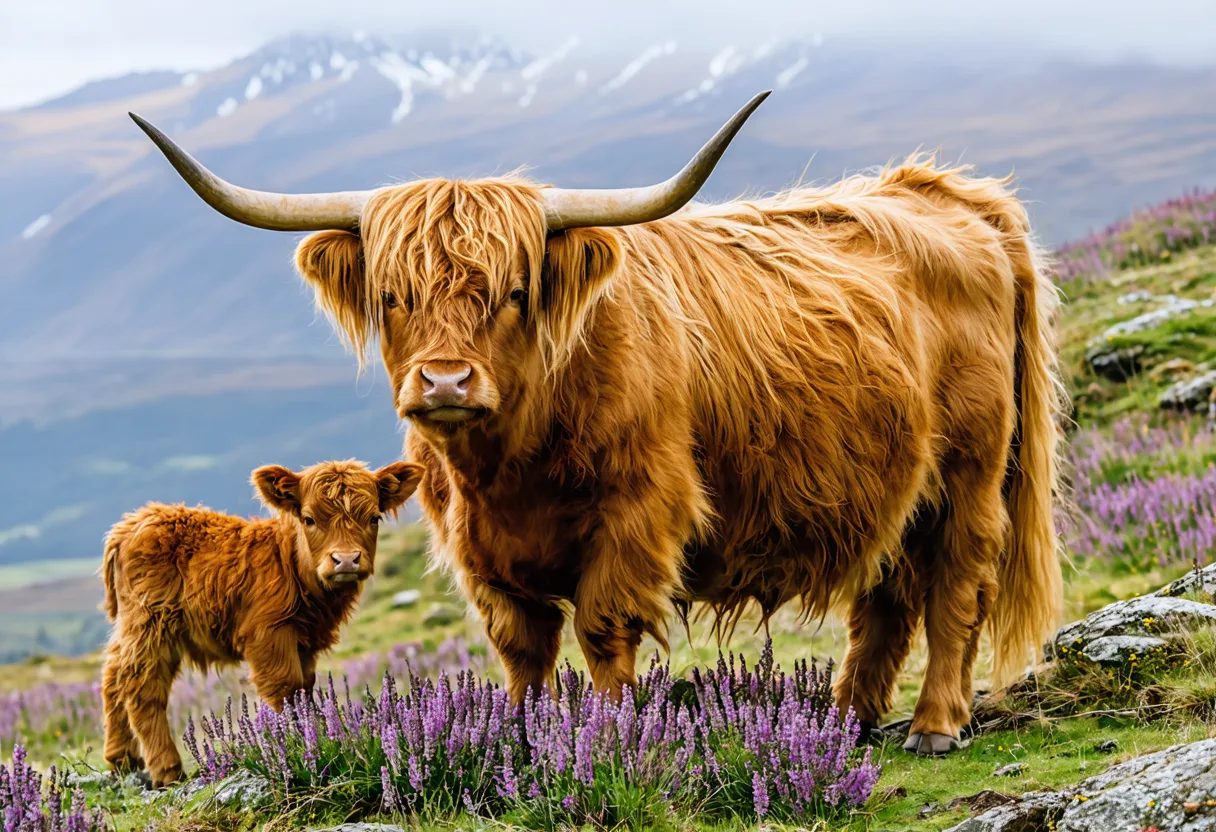
A Highland cow and her calf on a Scottish hillside
Built for the hills
A tough old breed
The Highland is one of the oldest registered breeds of cattle in the world. Written records go back to the 18th century, and the Highland Cattle Herd Book, first published in 1885, lists every pedigree since that time. The breed has stayed largely unchanged over the centuries, with its long, thick, flowing coat and its sweeping horns. It is exceptionally hardy, and it has a natural ability to make good use of poor grazing. Highland cows give birth to their calves outside, and they are seldom kept indoors. They are great mothers, and they are known for their long lives: many Highland cows are still breeding at over 18 years of age.
SourceFrom the islands
Kyloes, drovers and a castle
Long ago there were two types of Highland cattle: a smaller island type, usually black, and a larger mainland type, usually dun. The small island cattle, called Kyloes, were reared mainly in the Hebrides or Western Islands. These cattle mattered to Scotland's economy in the eighteenth century. At markets such as those of Falkirk or Crieff, many were bought by drovers from England, who took them south over the Pennines. From the late nineteenth century, Highland cattle were sent to other countries, including Argentina, Australia, Canada and the United States. In 1954, Queen Elizabeth II decided to keep a herd at Balmoral Castle, where they are still kept today.
SourceThe pictures on this page are AI-generated illustrations. The facts are checked against the sources linked.