Open your worlds
Your wish list — the plush you mean to keep.
Press Add to a collection on any plush in the shop: start a collection of your own, or keep it on your wish list. Sign in and both follow you to any device.
Open my wish list →Menu
Round little diggers
Rain frogs live in dry and fairly dry places in eastern and southern Africa. There are 21 kinds, and most live in southern Africa.
Walkers and diggers
Rain frogs walk rather than hop. They can dig backwards into the soil very quickly, using spade-like lumps on their feet.
SourceOut with the rain
Rain frogs spend most of the year underground. They come out after rain to eat small creatures such as ants, termites and beetles, which is how they got their name.
Source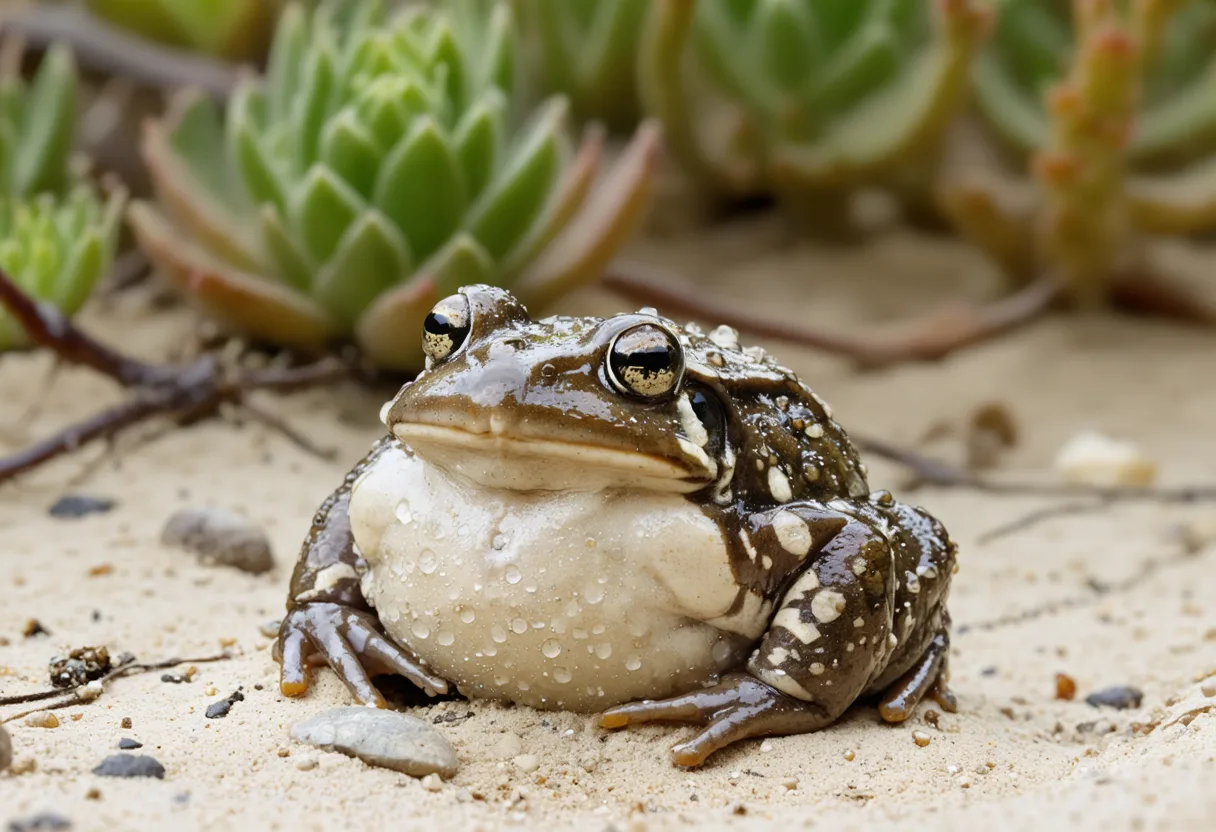
A Cape rain frog puffed up into a ball
The blow-up frog
The Cape rain frog
The Cape rain frog lives in the south-west of the Western Cape in South Africa. In Afrikaans it is called blaasoppie, which means 'blow-up', because when it is scared it puffs its body up into a ball. That makes it look much bigger to a predator. It cannot swim, but it can float. At mating time the male is too small to hold on to the female, so she makes a sticky liquid that glues him to her back. Her eggs are laid in a burrow she has dug, in groups of about 22. She stays nearby, and the young grow into little froglets without ever being tadpoles.
SourceFrog of the dunes
The desert rain frog
The desert rain frog lives on a narrow strip of sandy shore and dunes along the coast of Namibia and South Africa. Hardly any rain falls there, but the dunes are often wrapped in fog, which brings some moisture. It is plump and yellowish-brown, and sand often sticks to its skin. By day it rests in a burrow 10 to 20 centimetres deep, where the sand is moist. At night it comes out and walks across the dunes, leaving tracks behind it. It cannot hop. When it is threatened, it makes a high-pitched squeak.
SourceThe pictures on this page are AI-generated illustrations. The facts are checked against the sources linked.