Open your worlds
Your wish list — the plush you mean to keep.
Press Add to a collection on any plush in the shop: start a collection of your own, or keep it on your wish list. Sign in and both follow you to any device.
Open my wish list →Menu
Life in the kelp
The sea otter lives along the coasts of the North Pacific. Here are three things about how it lives.
Resting in rafts
Each sea otter finds its food alone, but sea otters tend to rest together in groups of all males or all females, called rafts. A raft usually holds 10 to 100 sea otters, and the largest ever seen held over 2,000.
SourceA seaweed anchor
To keep from drifting out to sea while they rest and eat, sea otters may wrap themselves in kelp.
SourceKeepers of the kelp forest
Sea otters are a keystone species, which means they have a big effect on the places where they live. In California's kelp forests they eat the urchins that graze on giant kelp, and without sea otters the urchins grow unchecked and devour the kelp, leaving bare places where only urchin-covered rocks remain.
Source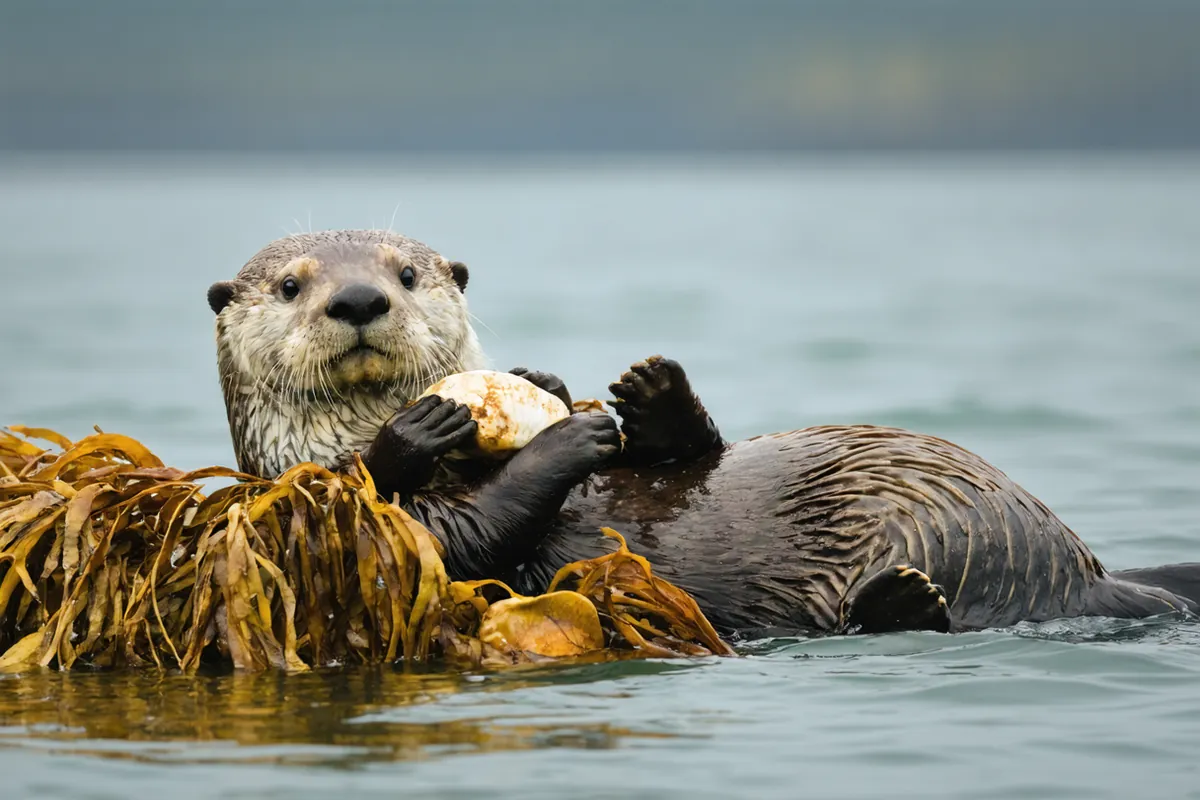
AI-generated illustration
Clever paws
The otter with a pocket and a rock
Along the coasts of the North Pacific, the sea otter is one of the few mammals that uses tools. Under each foreleg it has a loose pouch of skin that stretches across its chest. It stores the food it collects in there to bring to the surface, and it prefers the left pouch. Sometimes it carries a rock in there too. At the surface it eats while floating on its back, and it may pound hard shells against a rock on its chest to open them. Unlike most other sea mammals, it has no blubber to keep it warm. Instead it has the densest fur of any animal, with up to 150,000 hairs in every square centimetre.
SourceBack from the brink
The otters that nearly vanished
There were once perhaps 150,000 to 300,000 sea otters. From the 18th century, hunters and traders came from all over the world for their pelts. Sea otters were hunted for their fur from 1741 to 1911, and the fur trade killed about one million of them. So few were left, perhaps only 1,000 to 2,000 in the wild, that many people believed they would die out. In 1911, Russia, Japan, Great Britain (for Canada) and the United States signed a treaty that stopped the hunting. With protection, conservation work and otters returned to places they used to live, their numbers grew again. Today sea otters live in about two-thirds of their old range, but they are still endangered.
SourceThe pictures on this page are AI-generated illustrations, not photographs. The facts are checked against the sources linked.