Open your worlds
Your wish list — the plush you mean to keep.
Press Add to a collection on any plush in the shop: start a collection of your own, or keep it on your wish list. Sign in and both follow you to any device.
Open my wish list →Menu
Wonders of the shore crab
The common shore crab (Carcinus maenas)
↑ All about crabsThe crab in the rockpool
If you have ever been rockpooling or crabbing in the UK, the crab you met was probably a shore crab. It is found on all shores of Britain and Ireland.
It comes in many colours
Shore crabs can be green, brown, grey or red. A crab that waits a long time before moulting turns red rather than green.
SourceIt grows in jumps
A shore crab grows by moulting, and each moult makes it 20 to 33 per cent bigger. If conditions are good, a young crab takes about ten moults to reach 2 centimetres across in its first year.
SourceIt hides in plain sight
Green shore crabs are mostly found sheltering under seaweed, where their colour blends in with the background. They do most of their feeding at night, around high tide.
Source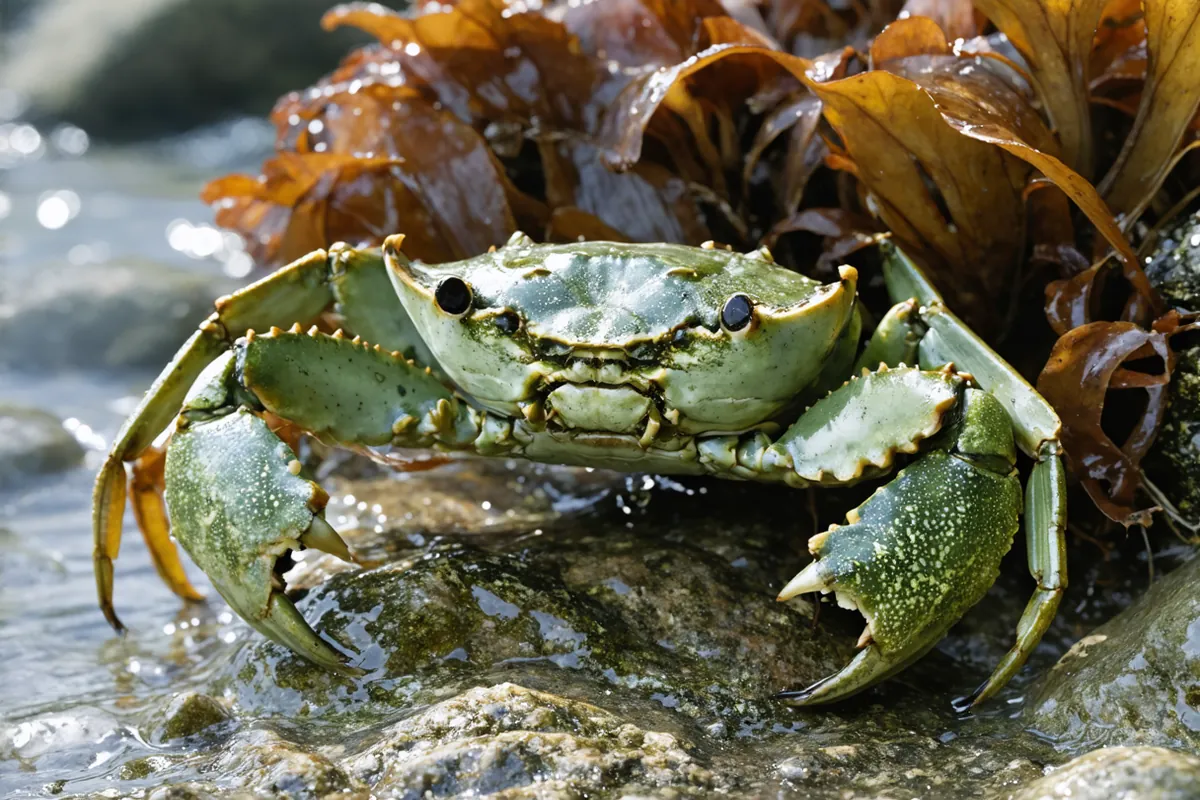
A shore crab on wet rocks beside the seaweed
Long journey
The crab that travelled the world
The common shore crab is native to the coasts of Europe and North Africa, but it has travelled much further. It has spread in several ways, such as on ships' hulls. It was first seen on the east coast of North America, in Massachusetts, in 1817. In 1989 it was found in San Francisco Bay, on the Pacific coast of the United States, and by 1999 it had reached British Columbia in Canada. In Australia it was first reported in the late 1800s, in Port Phillip Bay, Victoria, and it reached South Africa in 1983. In North America it is called the European green crab. It is now listed among the 100 of the world's worst invasive alien species.
SourceFamily life
A crab that carries thousands of eggs
Shore crabs have a careful way of starting a family. Before a female moults, a male carries her beneath his body, held by one of his legs. After she moults, while her shell is still soft, the male turns her over and they mate. Later the female carries her eggs in a mass held between her abdomen and the underside of her shell. One female was recorded carrying 185,000 eggs. She may carry them for up to four months, depending on the temperature, before they hatch in spring or summer. In the south of England, females carrying eggs can be found all year round.
SourceThe pictures on this page are AI-generated illustrations. The facts are checked against the sources linked.